


One Year Since the 2025 Infrastructure Report Card
 The American Society of Civil Engineers (ASCE) this week celebrates one year since the release of the 2025 Report Card for America’s Infrastructure. The report – widely recognized as the most cited infrastructure report in the nation – was introduced on March 25, 2025 at ASCE’s Solutions Summit, featuring category-by-category panel discussions with industry leaders and elected officials, including Congressman Sam Graves (R-MO), Senator Sheldon Whitehouse (D-RI), and Congressman Rick Larsen (D-WA). ASCE’s assessment advances the key issues, challenges, and opportunities in infrastructure development.
National Infrastructure Grades Show Measured Progress
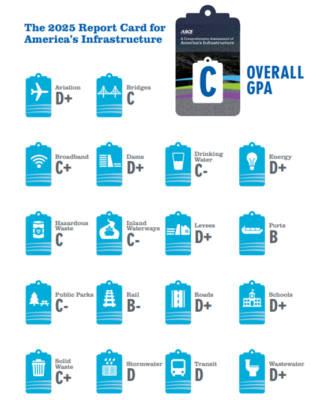
The 2025 Report Card for America’s Infrastructure assessed 18 categories, covering broadband as a new category. Overall, the country has seen progress, with the national grade improving from a ‘C-’ to a ‘C’ – the highest cumulative grade ever recorded since the quadrennial Report Card series began in 1998. Nearly half of the 18 categories received higher grades than four years previous – marking real momentum, largely from recent investments.
Impacts of Federal Investment and the IIJA

Federal funding is making a difference: increased investment (particularly from the $1.2 trillion Infrastructure Investment and Jobs Act, or IIJA) has helped lift historically low-performing sectors, and for the first time since 1998, no category received a ‘D-’. However, persistent weaknesses remain. Despite improvements, nine categories are still in the ‘D’ range, with stormwater and transit at the bottom, highlighting ongoing infrastructure deficiencies.
Uneven performance is evident across the 18 categories: grades range from a ‘B’ in ports to ‘D’ in stormwater and transit; meanwhile, energy and rail declined due to concerns about capacity, safety, and future demand. Broadband debuted at a ‘C+.’
What Infrastructure Deficiencies Cost American Households
These grades have real impacts on Americans. ASCE’s Bridging the Gap economic study found that faulty infrastructure – potholes damaging our vehicles, traffic delays leading to lost productivity and increased costs for products, aging water lines leading to spiking water rates, etc. – costs each American household $2,700 per year – this is down from $3,300 per year before the IIJA was passed. However, if we maintained IIJA funding beyond its current expiration date of 2026 and accepted these funding levels as the new baseline for infrastructure investment, faulty infrastructure would only cost each American household $2,000 per year.
 The Report Card highlighted three major systemic challenges:
- Need for sustained funding: Recent gains were largely driven by an influx of federal investments, and continued improvement will depend on reliable long-term investment to address backlogs and meet growing demand.
- Aging assets and climate vulnerability: Communities are increasingly exposed to extreme weather, underscoring the need for resilient infrastructure.
- Data gaps hinder decision-making: Many sectors lack reliable data, limiting effective planning, asset management, and targeted investment.
The U.S. is seeing early returns from increased infrastructure investment, but significant gaps remain—requiring sustained funding, better data, and a stronger focus on resilience to maintain progress.
State Infrastructure Grades Released Since March 2025
 Following the release of the Report Card, ASCE has continued issuing state infrastructure report cards highlighting performance across the country. Since March 2025, ASCE has released 11 state report cards—six saw grade increases, three remained unchanged, and one marked its first modern report card.

- Utah (C+, same as prior report card)
- Ohio (C, up from C- in prior report card)
- Nevada (C+, up from C in prior report card)
- Colorado (C-, same as prior report card)
- Idaho (C, up from C- in prior report card)
- Maryland (C, same as prior report card)
- Louisiana (C-, up from D+ in prior report card)
- California (C-, same as prior report card)
- Florida (C+, up from C in prior report card)
- West Virginia (D+, up from D in prior report card)
- North Carolina (C-, first modern report card)
The Report Card’s Impact
Since its launch, the 2025 Report Card for America’s Infrastructure has been mentioned more than 40,000 times in media outlets across the globe, including ABC, NBC, CNN, CBS News, FOX Business, Bloomberg, The New York Times, the Wall Street Journal, USA Today, and MorningBrew. The report shapes the media’s understanding of our infrastructure needs and provides national context when incidents or stories occur that relate to our built environment. ASCE members contributed to more than 40 interviews during the week of launch and have done dozens more to break down the report with national, international, and local outlets since the report was released.
ASCE Hosts Webinar Series Exploring Solutions
With a focus on implementing on-the-ground strategies, ASCE has elevated infrastructure solutions through its Making the Grade webinar series. Webinars highlight each category of infrastructure with emphasis on how key criteria such as funding and resilience are being met through project design and implementation. In recent months, ASCE has brought together engineers and infrastructure professionals to explore drinking water & wastewater, aviation, ports & inland waterways, and stormwater. Webinars across additional infrastructure categories are planned this year.
What Comes Next for U.S. Infrastructure Policy
Moving forward, maintaining focus on infrastructure is as important as ever. With surface transportation reauthorization and the Water Resources Development Act (WRDA) reauthorization on the horizon, policymakers have a critical opportunity to build on recent progress and address persistent gaps. Continued investment will be essential to modernize aging systems and meet growing demand. A stronger emphasis on resilience will help communities withstand increasingly frequent and severe weather events. Additionally, advancing innovation will help stretch limited resources further and deliver better outcomes.
ASCE’s Ongoing Commitment to Infrastructure Advancement
ASCE remains committed to elevating infrastructure as a national priority and supporting policies that ensure a more sustainable, resilient, and future-ready system. Strong, resilient infrastructure is essential to our economy, our communities, and our future. ASCE continues to advocate for the policies and investments that make meaningful progress possible — but lasting improvement requires sustained engagement from engineers, policymakers, partners, and the public.
Here’s how you can help drive the conversation forward:
- Explore your state’s latest infrastructure grades and see where progress is being made — and where challenges remain.
- Share the 2025 Report Card with colleagues, stakeholders, and community leaders to elevate infrastructure as a priority at all levels of government.
- Stay engaged with ASCE advocacy efforts to support long-term, reliable funding for critical systems across the country.
- Sign up for updates to receive new state Report Cards, policy alerts, and opportunities to act.