


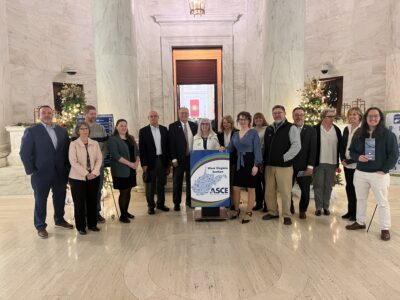
On Wednesday, December 17, the West Virginia Section of the American Society of Civil Engineers (ASCE) released its 2025 Report Card for West Virginia’s Infrastructure at the state capitol building in Charleston, giving the state an overall grade of a ‘D+’, an improvement of the ‘D’ it received in their 2020 report card. Reliable, resilient infrastructure is critical for the state’s economy, global competitiveness, and quality of life. West Virginia is the first state to include all 18 chapters aligned with the national report card and also featured research contributions from more than 50 Fairmont State University students.
A ‘D+’ means that West Virginia’s infrastructure is facing significant needs, with aging assets, rugged terrain, and inadequate funding, in part driven by weakened user fees due to a falling population. Yet, the state’s infrastructure is trending upward. Three of the five categories that were
assessed in the 2020 report card saw improvements, and the overall grade increased, in part thanks to record investments through the Infrastructure Investment and Jobs Act (IIJA).
Three of the five categories assessed in 2020 saw an improvement
Dams (D+), Drinking Water (D+), and Roads (C-) all saw slight increases since the last report card in 2020. However, needs remain significant – for example, the estimated cost to address dam rehabilitation needs exceeds $1 billion, with limited funding currently identified. Many drinking water systems rely on pipes that are more than 50 years old, and some utilities lose up to half of their treated water through leaks.
Two of the five categories assessed in 2020 received the same grade
- Bridges (D+): Approximately 19% of the state’s bridges are rated in poor condition, compared to about 7% nationally. While the state’s bridges are safe to drive on, this represents a significant need. The funding gap for bridges alone is estimated at $400 million.
- Wastewater (D): Only about 47% of West Virginians are served by regulated sewer systems, leaving many households reliant on failing or aging septic systems. West Virginia ranks first nationally in per-capita wastewater infrastructure needs, with an estimated $3.6 billion still required.
Thirteen new categories were assessed in the 2025 Report Card
- Aviation (C-): West Virginia’s airports support the economy, education, military, and tourism, handling ~250K flight operations and 350K enplanements in 2024. West Virginia’s aviation scored better than the national grade of ‘D+’. Despite contributing $1.6 billion annually, challenges include aging terminals, on-time performance issues, and funding gaps.
- Broadband (D+): Access remains limited and unreliable, but major investments are underway. ARPA funded $275 million in fiber projects, and $625 million of BEAD funds are expected to close remaining gaps. With these initiatives, West Virginia is positioned to become a national leader in broadband connectivity.
- Energy (D): West Virginia produces nearly twice the energy it consumes, relying on coal for about 90% of electricity. Aging pipelines, outages, and flooding underscore infrastructure needs. The nuclear ban repeal in 2022 and $1 billion in utility investments have improved reliability, but challenges persist.
- Hazardous Waste (D): West Virginia tracks 179 hazardous waste sites and ranks 21st nationally for waste released per square mile. Oversight includes 114 RCRA-regulated generators, 8,840 underground and 42,240 aboveground storage tanks. Fourteen Superfund sites—11 on the National Priorities List—are all in floodplains, with only 3 completed. Strengthening asset management, permitting, and public accountability are essential.
- Inland Waterways (D-): West Virginia’s 425 miles of navigable rivers moved 45.7 million tons of cargo worth $3.4 billion in 2021. Aging lock and dam infrastructure and declining barge traffic challenge reinvestment. USACE prioritizes limited resources via asset management, but modernization needs remain. Federal investment and improved multimodal access are critical.
- Levees (D+): 21 levee systems protect 34,000 people, $7.2 billion in property, and 200 miles of roads. Average age: 53 years. All are locally maintained with limited resources. Expanding funding (e.g., Flood Resiliency Trust Fund) and improving maintenance practices are key for long-term protection.
- Ports (D+): West Virginia’s two federal port districts support 127,000 jobs and $1.8 billion in tax revenue. However, defunding of the Public Port Authority and aging infrastructure hinder strategic planning. Most facilities are privately owned and lack asset management; reinvestment and statewide coordination are needed.
- Public Parks (D): Tourism is valued, with $7M million invested in Hawks Nest State Park upgrades and free vacation guides released in 2022. Deferred maintenance—such as 150-year-old tunnels on North Bend Rail Trail—poses safety risks.
- Rail (C-): West Virginia’s 2,401 miles of rail moved 52.7 million tons of freight in 2019, projected to decline to 29.2 million tons by 2050 despite rising value. Under-capacity and declining demand challenge the system, though tech investments improve maintenance. Passenger rail serves 143,000 passengers annually but struggles financially.
- Schools (D-): 85% of West Virginia school facilities fall below modern standards; 543 of 637 rated poor or fair. SBA receives $50 million annually vs. $300 million needed; funding gap now $3.2 billion due to rising costs. Infrastructure remains severely underfunded and inadequate.
- Solid Waste (C+): 16 landfills managed over two million tons of municipal solid waste in 2023, with residents generating 5.7 lbs/person/day (above the national average). Landfills are at 54% capacity, but recycling access is limited—especially in rural areas lacking drop-off or curbside service. Enhanced recycling, asset management, and resilience are needed.
- Stormwater (D-): Infrastructure averages 80 years old, with unknown conditions and minimal maintenance records. Flooding is frequent due to outdated systems and vegetation loss. $49 million federal funds in 2025 help, but stormwater projects remain underfunded, especially in rural areas.
- Transit (D): West Virginia’s 18 transit providers face severe funding gaps; state support is $1.28 per capita (ranking 37th nationally). Lack of non-federal match jeopardizes the use of $195 million IIJA funds. Systems struggle to maintain state-of-good-repair and expand coverage.
The path forward
Despite the positive trend since 2020, West Virginia’s infrastructure faces significant needs. ASCE has five recommendations to increase the grade in West Virginia:
- Establish sustained statewide investments to address aging assets, maintenance backlogs, and modernizing infrastructure for future economic and demographic needs. Strengthening access to federal grants can also help address funding issues.
- Ensure safety is a fundamental priority across all infrastructure systems. This includes increasing inspection capacity for dams and levees, conducting statewide assessments to identify and prioritize school safety retrofits, and accelerating the replacement of lead service lines in drinking water systems.
- Accelerate efforts to improve the resilience of infrastructure to ensure that critical systems can withstand climate-related threats and other hazards.
- Increase the pace of technology adoption. The state should begin phasing in new and emerging technologies such as improved disposal technologies for hazardous and solid waste, distributed power units for rail, and updated intermodal logistics and cargo handling systems for freight.
- Address population decline by strategically investing in infrastructure systems that support daily life and shape community vitality, such as broadband systems, transit operations, water systems and more.