


America’s public parks play a critical role in the nation’s communities, providing space to unwind, congregate and in some cases, provide protection from natural disasters such as flooding. On September 29th the American Society of Civil Engineers (ASCE) hosted a webinar, Making the Grade: Public Parks, this program brought together infrastructure experts to discuss both challenges and solutions sustaining these important public assets.
The webinar explored key findings from the 2025 Report Card for America’s Infrastructure, which assigned a C- to the nation’s parks – an improvement from their 2021 grade, but an indication that deficiencies remain.
Understanding the Grades
Released every four years, the Report Card evaluates the condition and performance of the nation’s infrastructure across a range of criteria, including:
- Safety
- Resilience
- Innovation
- Funding
- Capacity and condition
While improvements in park infrastructure contributed to higher grades in 2025, aging facilities, limited funding for maintenance and rehabilitation, and increasing impacts from extreme weather continue to pose serious risks to communities nationwide.
What Infrastructure Leaders Said
The September 29th webinar brought together experts from across the public park community to provide valuable insights into current needs, emerging solutions, and opportunities for improving infrastructure performance.
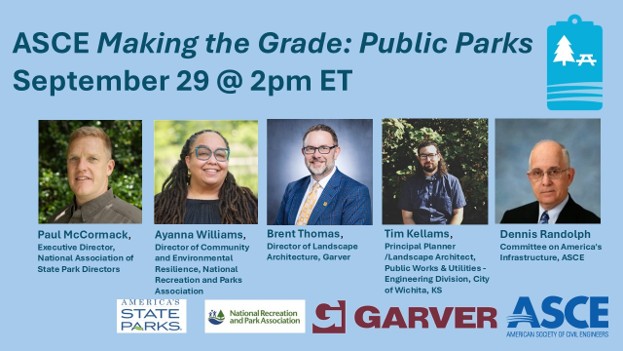
Panelists included:
- Paul McCormack, Executive Director, National Association of State Park Directors
- Ayanna Williams, Director of Community and Environmental Resilience, National Recreation and Parks Association
- Brent Thomas, Director of Landscape Architecture, Garver
- Tim Kellams, Principal Planner/Landscape Architect, Public Works & Utilities – Engineering Division, City of Wichita, KS
- Dennis Randolph, Committee on America’s Infrastructure, ASCE
Together, panelists discussed the factors behind the 2025 grades, ongoing challenges facing owners and operators, and strategies for building safer and more resilient infrastructure systems.
Special thanks to Garver for sponsoring this event.
You can also access the slides used for this presentation here.