House Introduces WRDA 2026 Bill
On June 26th, the House Transportation & Infrastructure Committee introduced H.R. 9497, the Water Resources Development Act (WRDA) of 2026. Introduction of the House’s WRDA bill marks the culmination of a process that started in the fall of 2025 with the committee’s first WRDA hearing. This year’s WRDA bill authorizes 131 new project feasibility studies and 10 new water resources projects for the U.S. Army Corps of Engineers (Corps). It also includes several new policy provisions supporting water resources infrastructure resilience, support for flood control programs, and provisions to improve project delivery.
House WRDA Bill Includes ASCE Dam Safety Priority
The bill also includes several provisions which align with ASCE’s top policy priorities for WRDA 2026. Most notably, H.R. 9497 includes a 5-year reauthorization of the High Hazard Potential Dam Rehabilitation Grant Program (HHPD Program). The HHPD program is a competitive grant program, and one of the only federal funding sources for rehabilitation of dams. In this case, grants support repair and rehabilitation of high-hazard potential dams—water control structures whose failure would result in loss of life or significant destruction of property. The program’s authority is set to expire on September 30th of this year. The bill also makes a needed adjustment to the National Dam Safety Program State Assistance Grant allocation formula. In 2024, the final WRDA agreement included a provision incorporating low-head dams into the State Assistance Grant allocation formula. Currently, most states lack the capacity to accurately count low-head dams, and data on these structures is still being collected nationwide for development of the National Low-Head Dam Inventory. Requiring states to account for low-head dams in their grant applications would likely cause most states to see reduced funding to support inspection and monitoring, emergency preparedness, and staffing needs. This year’s WRDA bill addresses this by removing low-head dams from the allocation formula, ensuring states do not lose out on needed funding while allowing the development of the low-head dam inventory to continue.
WRDA 2026 Supports Maintenance Dredging and Navigation
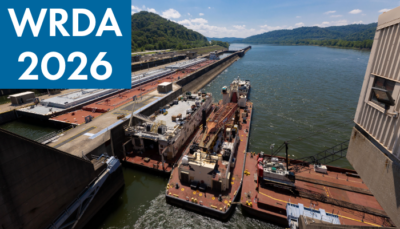 Support for dredging activities and navigation projects also received attention in this year’s House WRDA bill. Among ASCE’s priorities for WRDA 2026 was support for maintenance dredging activities, which would help to create deeper channel depths and allow for larger cargo ships to enter U.S. ports. This will not only support the overall health of navigation infrastructure but will also help increase trade and economic growth. To facilitate these goals, the bill includes a provision requiring the Secretary of the Army to increase coordination with non-federal stakeholders, including state and local governments to improve the planning and efficiency of maintenance dredging activities. It would also require the Corps to complete a report examining the health of the nation’s inland waterways and the condition and reliability of inland waterways infrastructure projects. This could help shed light on where challenges to infrastructure systems are and allow for development of new solutions to improve the health of inland waterways.
Bill Targets Growing Corps Water Resources Project Backlog
Finally, this legislation takes steps to help address the Corps’ growing water resources project backlog. Over time, many water resources projects authorized under previous WRDA’s have not received proper funding from congressional appropriators. This and other challenges have led to delays in project completion and increased costs. The backlog has been cited as growing to a level of over $100 billion. To help address this, the bill requires, to the extent possible, that the Corps expedite the completion of several water resources infrastructure projects nationwide authorized under previous WRDA bills. The bill also allows for accelerated completion of inland waterways projects in areas where a federal emergency has been declared.
National Levee Safety Program Left Out of House WRDA Bill
An ASCE priority that was not addressed in this year’s measure is the reauthorization of the National Levee Safety Program. The National Levee Safety Program was last reauthorized through FY 2028 in WRDA 2022. In that time, the program has made significant advancement by developing the first National Levee Safety Guidelines, which provide a set of best practices for improving the safety and effectiveness of the nation’s levees. The Corps has also completed risk assessments for all levees within its portfolio and significantly strengthened the National Levee Database. This progress allowed ASCE to increase the grade for the nation’s levees to “D+” in the 2025 Report Card for America’s Infrastructure. Reauthorizing the program now will ensure its uninterrupted development and allow the Corps to support states in improving the overall safety of levee systems nationwide.
Next Steps Uncertain for House WRDA 2026 Bill
Introduction of the 2026 Water Resources Development Act is an important step toward ensuring WRDA passes on schedule for the 7th time since 2014. However, its path in the House remains uncertain. The Transportation & Infrastructure Committee had previously scheduled a markup for the bill for Wednesday, July 1st. However, continued debate and challenges on the House floor related to other legislative matters pushed House leadership to cancel votes for the rest of this week, resulting in the postponement of Wednesday’s markup without a new date set. Legislative disputes may continue even after Congress returns from the 4th of July holiday recess, leaving the next steps for the House WRDA bill potentially in limbo. The Senate Environment & Public Works Committee is expected to release its own version of WRDA 2026 this summer as well. ASCE will continue to monitor developments surrounding WRDA and will keep members informed of those developments.