


Each Earth Day offers an opportunity to reflect on how infrastructure decisions shape the natural and built environments for generations. As weather patterns intensify, resulting in more heat, flooding, and water scarcity, civil engineers are increasingly embracing green infrastructure and nature‑based solutions to improve sustainability and resilience—the ability of infrastructure systems to withstand, adapt to, and recover from disruption.
That focus on resilience is echoed in ASCE’s 2025 Report Card for America’s Infrastructure, which found that while the nation’s overall grade improved to a “C,” many systems remain vulnerable to climate stressors, aging assets, and capacity constraints. The report underscores that future infrastructure investments must prioritize long‑term performance and adaptability, not just near‑term repairs.
What Engineers Mean by Green Infrastructure
Green infrastructure integrates natural processes into the delivery of traditional infrastructure services such as transportation, water management, energy, and public space. These approaches—from floodable parks and restored wetlands to permeable pavements and urban tree canopies—are increasingly recognized as cost‑effective resilience tools.
The 2025 Report Card highlights that sectors such as stormwater, wastewater, levees, and public parks remain among the most exposed to climate risk. Nature‑based and hybrid solutions can help address these vulnerabilities by absorbing excess water, reducing urban heat, and extending asset service life—often at lower life‑cycle costs than conventional gray infrastructure alone.
These solutions are being implemented in communities across the globe.
Reimagining Urban Corridors in Dubai
Few environments pose greater engineering challenges than dense cities in arid climates. In Dubai, planners
and engineers are proposing to transform a major transportation corridor into a multifunctional green system
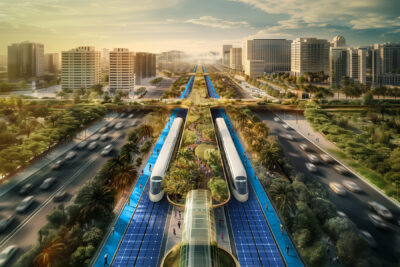
designed to improve livability, mobility, and environmental performance.
The Dubai Green Spine concept would convert more than 60 kilometers of highway into a linear urban corridor, integrating renewable energy, shaded pedestrian and cycling routes, urban agriculture, and extensive tree canopies. In addition to reducing urban heat and improving air quality, the project would enhance system resilience by diversifying transportation options and mitigating climate‑related stresses on public infrastructure.
Rethinking Water Resilience with Offshore Desalination
Aging drinking water and wastewater infrastructure face increasing pressure from drought, population growth, and extreme weather.

Emerging offshore desalination concepts—such as modular deep‑sea systems—illustrate how engineers are pursuing resilience through innovation. By leveraging natural ocean pressure, reducing land use impacts, and limiting ecological disruption, these systems provide redundancy and adaptability in regions facing chronic water scarcity.
Curitiba: A Long‑Term Blueprint for Resilient Urban Growth
Curitiba, Brazil, offers a powerful example of how resilience is built through consistent, long‑range planning. For nearly six decades, the city has followed a master plan that integrates land use, transit, flood management, and environmental preservation as a single system.
By using parks and green corridors to manage floodwaters rather than relying solely on concrete channels, Curitiba has reduced flood risk while creating public space and protecting critical infrastructure. This approach reflects the Report Card’s emphasis on planning infrastructure for its full life cycle, accounting for changing climate conditions rather than reacting after failures occur.
Infrastructure That Honors Place in New Zealand
In New Zealand, a proposed pedestrian bridge spanning the Te Awa Kairangi river demonstrates how infrastructure can enhance resilience while honoring environmental and cultural context.

The bridge’s timber construction and nature‑inspired form support floodplain connectivity and multimodal transportation while respecting Māori principles of kaitiakitanga, or stewardship. It functions as a civic space that encourages interaction with the river ecosystem while supporting flood resilience and multimodal mobility.
Planning Cities That Can Withstand Tomorrow’s Challenges
Across the United States, engineers are helping communities adapt to climate realities by restoring natural systems that protect infrastructure. Greenways, tree canopies, and floodplain reconnections reduce flood risk, mitigate heat, and improve public health through cost-effective alternatives to expanding conventional infrastructure.
These strategies also align with ASCE’s call for forward‑thinking policies and investments that reduce risk and avoid higher costs from future failures.
Earth Day is a reminder that infrastructure choices are resilience choices. The 2025 Report Card makes clear that progress is possible—but only if investments are sustained and designed with future conditions in mind.
Green infrastructure can help us meet that challenge. By working with natural systems, the profession is helping communities build infrastructure that is sustainable, adaptable, durable, and ready for uncertainties ahead.
On this Earth Day, these projects highlight the essential role engineers play in creating infrastructure that protects public health, supports economic vitality, and strengthens resilience—for today and for generations to come.