


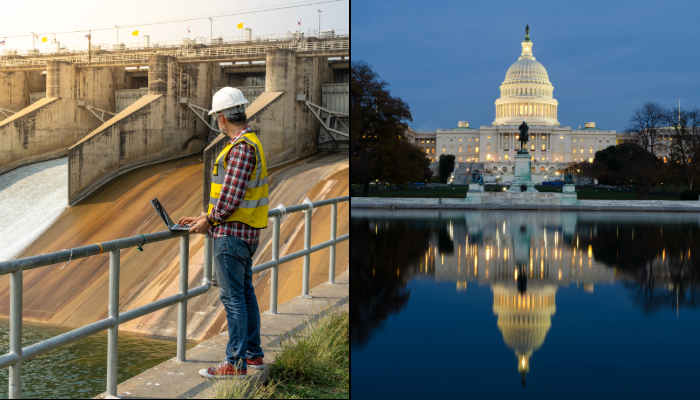


With the start of the New Year, ASCE is preparing for Congress’s consideration of the 2026 Water Resources Development Act (WRDA). WRDA provides biennial authorization to water resources projects at the U.S. Army Corps of Engineers that improve the nation’s flood control capabilities, navigation, and resilience against increasingly extreme weather events. It also offers an opportunity to make significant changes to programs and laws that drive U.S. policy on water resources infrastructure such as dams, levees, ports, and inland waterways. This week, ASCE released its top policy priorities for inclusion in WRDA 2026.
Building on Recent WRDA Legislative Progress
Since 2014, Congress has worked in a bipartisan manner to pass WRDA on schedule every two years. This provides USACE with needed predictability to prepare its work schedule, allow new projects to get underway, and implement common sense policy changes. In 2024, WRDA included several key policy changes strongly supported by ASCE. This included reauthorization of the National Dam Safety Program, ASCE’s top WRDA priority in 2024, as the program’s statutory authority had run out at the end of the previous year. WRDA 2024 also required the incorporation of low-head dams into the National Inventory of Dams, building on progress made in WRDA 2022 which authorized the creation of a national inventory of low-head dams.
Strengthening the National Dam Safety Program
ASCE’s priorities for 2026 also aim to build on progress made on dam safety since 2021, progress which resulted in a grade increase for the nation’s dams from “D” to “D+” in the 2025 Report Card for America’s Infrastructure. This year, ASCE supports the reauthorization of the High Hazard Potential Dam Rehabilitation Grant Program (HHPD Program), which is set to expire at the end of FY 2026. The HHPD program is one of the few federal programs that provides a funding stream to support dam repair and rehabilitation. HHPD grants are competitive and support repair to those dams which would, in the event of a dam failure, likely result in loss of life. H.R. 5414, the Dam Assessment and Mitigation Support (DAMS) Act, reauthorizes this critical program for five years, and makes changes to federal law to improve access to these grant funds. ASCE supports the inclusion of H.R. 5414 in WRDA 2026. ASCE also supports eliminating low-head dams from the National Dam Safety Program’s State Assistance Grant allocation formula. Currently, this formula is determined by several factors, including total number of dams in a state. WRDA 2024 also added low-head dams to the formula’s criteria, creating challenges for allocation of funds to states, many of which do not yet have the capability to count or properly regulate its low-head dams. Removing the low-head dam criterion, at least until the inventory of low-head dams is allowed to more fully develop, will allow funds to be more fairly allocated to state dam safety programs.
Improving Levee Safety and Reauthorizing the National Levee Safety Program
Much like ASCE’s 2025 grade for the nation’s dams, levees also received a boost on the 2025 Report Card (also “D” to D+”) in large part due to progress made developing the National Levee Safety Program. This included completion of National Levee Safety Guidelines and improvements to USACE’s levee rehabilitation grants. To build on this, ASCE is proposing reauthorization of the National Levee Safety Program through 2033. The program was nearly reauthorized in 2024 when the House included it in their own WRDA bill, however, this provision did not make it through conference negotiations and was not included in the final 2024 WRDA agreement. Reauthorizing the program, which is set to expire in 2028, will allow the program to continue its development and assist states in standing up their own levee safety programs and improving safety regulations for the nation’s levees.
Enhancing Port Competitiveness Through Harbor Maintenance Investments
ASCE is also asking Congress to continue to spend down the Harbor Maintenance Trust Fund (HMTF) to support maintenance dredging activities. In 2024, WRDA included improvements to the nation’s navigation and trade routes by adjusting the Inland Waterways Trust Fund (IWTF) cost share formula to reduce the share of funding for inland waterways projects coming from the IWTF to 65% of cost, a recommendation in ASCE’s 2021 Report Card. This year, ASCE is supporting improvement of the nation’s ports by urging Congress to spend down the balance of the HMTF to improve channel depth of the nation’s ports through maintenance dredging. This will allow for larger cargo ships to enter U.S. ports, improve trade competition, and generate economic activity.
Addressing the Growing Backlog of USACE Water Resources Projects
Finally, ASCE is urging Congress to take steps to address the growing backlog of USACE water resources projects. The current backlog has been cited to be at least $100 billion. Many projects that are being authorized in WRDA have not been able to receive timely appropriations to allow them to get underway. This creates challenges for water resources infrastructure resulting in project delays that can affect project design and increase costs. ASCE is encouraging the relevant Congressional committees- including appropriators- to work together to formulate strategies to address this project backlog before it becomes unsustainable.
ASCE’s Continued Engagement Throughout the Water Resources Development Act 2026 Process
As Congress moves forward with its process for WRDA 2026, ASCE will remain engaged with House and Seante offices as well as committees. ASCE will continue to strongly advocate for its 2026 policy priorities throughout the entire WRDA cycle and looks forward to once again celebrating timely passage of WRDA by the end of this year.